Trump says SI. Musk says superintelligence. What should your business call it?
On September 22, President Trump told the United Nations General Assembly that the U.S. government will stop saying “artificial intelligence.” From now on, he said, “all United States documents” will call it “super intelligence.” His reason: “The use of the word artificial makes intelligence fake; it makes it sound fake, and it is not fake.”
The State Department put it into practice within a day. An email to staff in its Bureau of International Organization Affairs, subject line “Change in Nomenclature AI to SI,” told diplomats: “We will be using 'SI' in all remarks, positions and press elements moving forward.”
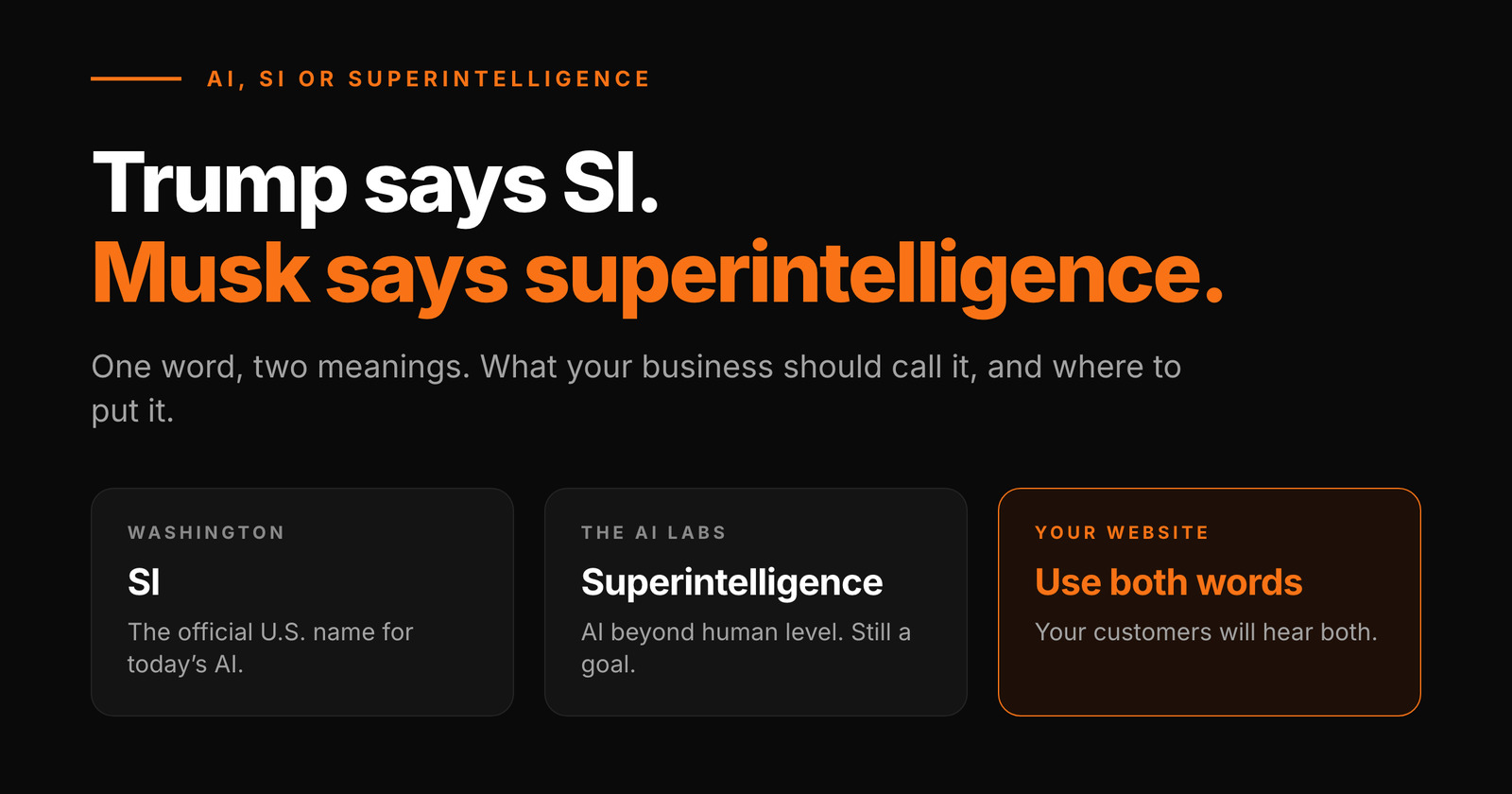
Elon Musk, Sam Altman and Mark Zuckerberg have been saying “superintelligence” for months, and they mean something different by it. If your business uses AI or sells anything built on it, you're going to hear both versions of the word. So are your customers.
Who is actually calling it SI?
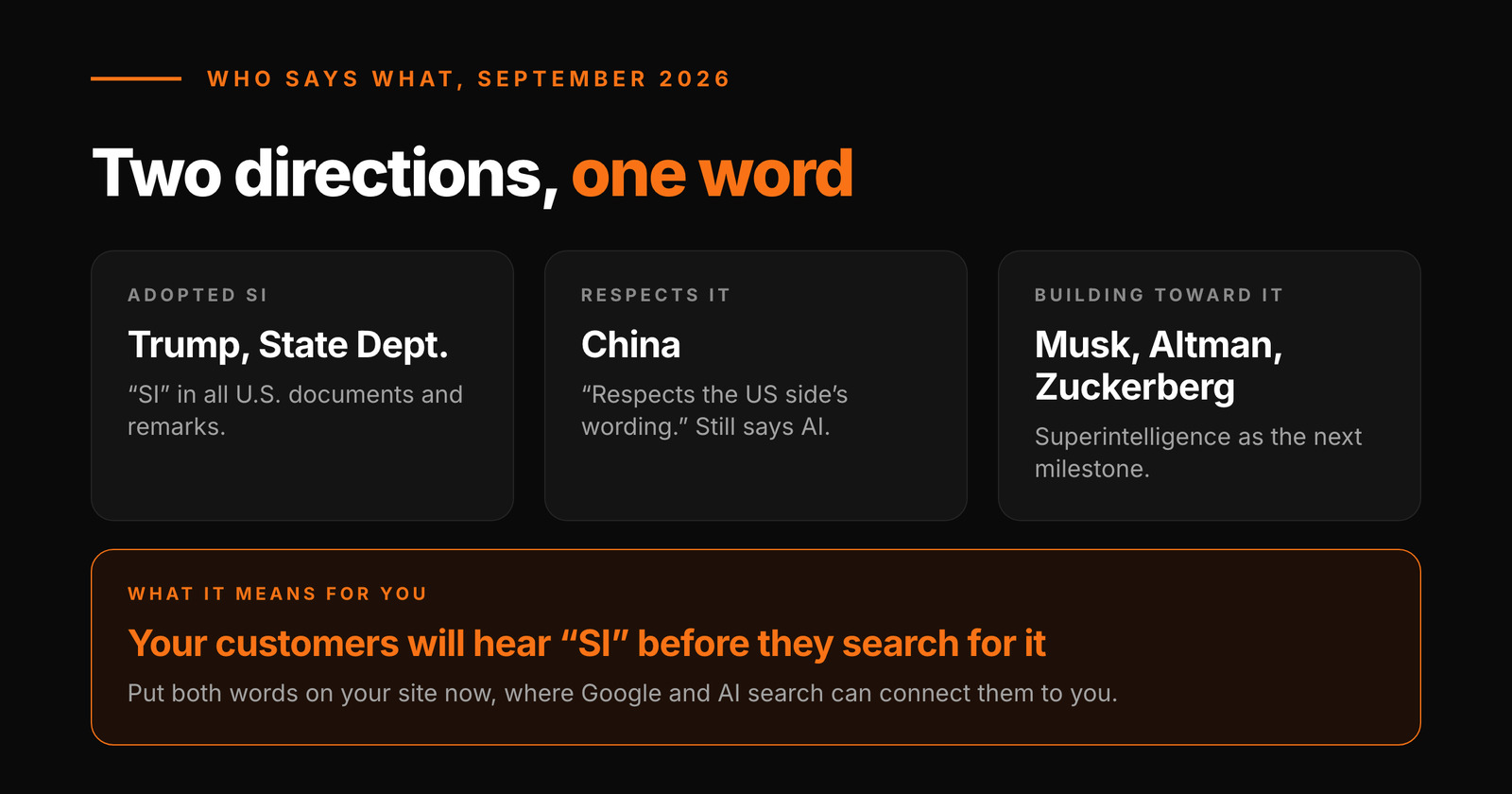
So far, the U.S. government. The president's directive covers official documents, and the State Department email extends it to remarks and press materials. Expect to see SI in agency announcements, grant language and the news coverage that quotes them.
China's response is worth reading closely. After a state dinner on September 25, Trump wrote that Xi Jinping “seemed to like” the new name. The next day China's foreign ministry said it “attaches importance to the US side's position and respects the US side's wording.” That's polite, and it isn't adoption. When Xi spoke at the White House that week, he said AI, and talked about keeping it “always under human control.”
What do Musk, Altman and Zuckerberg mean by superintelligence?
Something that doesn't exist yet. In the tech industry, superintelligence means AI that does nearly all work better than people do, and the largest companies say openly that they are building toward it.
- Musk said in an interview released September 26 that robots and AI will lead to “effectively universal high income,” and that it isn't clear money will even matter.
- Altman told the India AI Impact Summit in February that OpenAI may be “only a couple of years away from early versions of true superintelligence.”
- Zuckerberg reorganized Meta's AI work into Meta Superintelligence Labs, with the goal of “personal superintelligence” for everyone.
- Ilya Sutskever, an OpenAI co-founder, named his company after the goal. Safe Superintelligence Inc. signed a multibillion-dollar partnership with NVIDIA in July.
Some researchers object to the rename for exactly this reason. Simon Coghlan, a digital ethics lecturer, called it “misleading,” because the word already had a meaning in the field.
So is it AI or SI?
When the government says SI, it means the tools you can use today: ChatGPT, Claude, Gemini, an AI receptionist that answers your phone at night. When a tech CEO says superintelligence, they mean a future system smarter than any person. Same word, two different claims.
For a small business, the first meaning is the one that matters. Nothing about the tools changed on September 22. The name changed, and names spread fast once the government and the news start using them. Plenty of people never liked “artificial” anyway.
What should my business call it?
Call it what your customers call it, and put both words where search engines can read them. Today most people still type “AI” into Google. Over the next year more of them will hear “SI” on the news, and some will start searching for it. The businesses that show up for both will be the ones that wrote both down.
In practice, that means:
- A question on your FAQ page asking whether you work with SI, with a plain answer. AI search engines pull heavily from FAQ content, for reasons we cover in you don't rank into an AI Overview.
- Both terms on the pages that describe your AI services, the first time you mention them. “AI (now officially called SI by the U.S. government)” is enough.
- The same on your Spanish pages if you have them, written by someone who speaks Spanish rather than run through a translator.
Leave your product names and your company name alone. If SI sticks, you can lean further in later. If it fades, you haven't rebuilt anything.
Does the new name change how customers find you?
No. Google and AI search still answer questions from content they can find and trust: your Google Business Profile, your website, the pages that explain what you do. A business that isn't findable under “AI” won't become findable under “SI.” Get found first, tell your story in writing, then add the tools (the reasoning is in why AI is step four, not step one). That order holds whatever Washington calls them.
We made the change on our own site the same day we wrote this. The FAQ on our homepage now answers the SI question, and the file we publish for AI engines says plainly that SI and AI mean the same thing when we use them.
Frequently Asked Questions
- What is SI, or Super Intelligence?
- SI stands for Super Intelligence, the name the U.S. government adopted for artificial intelligence in September 2026. President Trump directed that official documents use it, and the State Department told diplomats to use “SI” in remarks and press materials. It refers to the same AI tools people already use.
- Is SI different from AI?
- Not in the government’s usage. SI is a new name for the same technology. In the tech industry, “superintelligence” also has an older meaning: a future AI that outperforms people at nearly everything, which does not exist yet.
- Why did the U.S. change the name from AI to SI?
- President Trump said at the United Nations on September 22, 2026 that “the use of the word artificial makes intelligence fake; it makes it sound fake, and it is not fake.”
- Is China using the term SI?
- Not officially. China’s foreign ministry said it “respects the US side’s wording,” but Chinese officials, including Xi Jinping, have kept saying AI in public.
- What do Elon Musk and Sam Altman mean by superintelligence?
- AI that is better than people at nearly all work. Altman has said OpenAI may be a couple of years from early versions of it, Meta has a division called Meta Superintelligence Labs, and Musk ties it to a future of robots and “effectively universal high income.” None of them are describing a product you can buy today.
- Should my business say AI or SI?
- Both. Most customers still search for AI, and more of them will hear SI as the government and the news use it. Put both terms on your FAQ page and on the pages that describe your AI services, and keep your product and company names as they are.
Ready to find out where you stand?
Get a free business audit.
We'll review your digital presence, competitive position, and where AI can make the biggest difference, at no charge.
Request your free snapshot
John Rounds
Founder & AI Implementation Specialist at Doble AI. Bilingual AI implementation, with 20+ years of international experience across 50+ countries. Builds and runs AI systems for Colorado businesses in both English and Spanish markets.