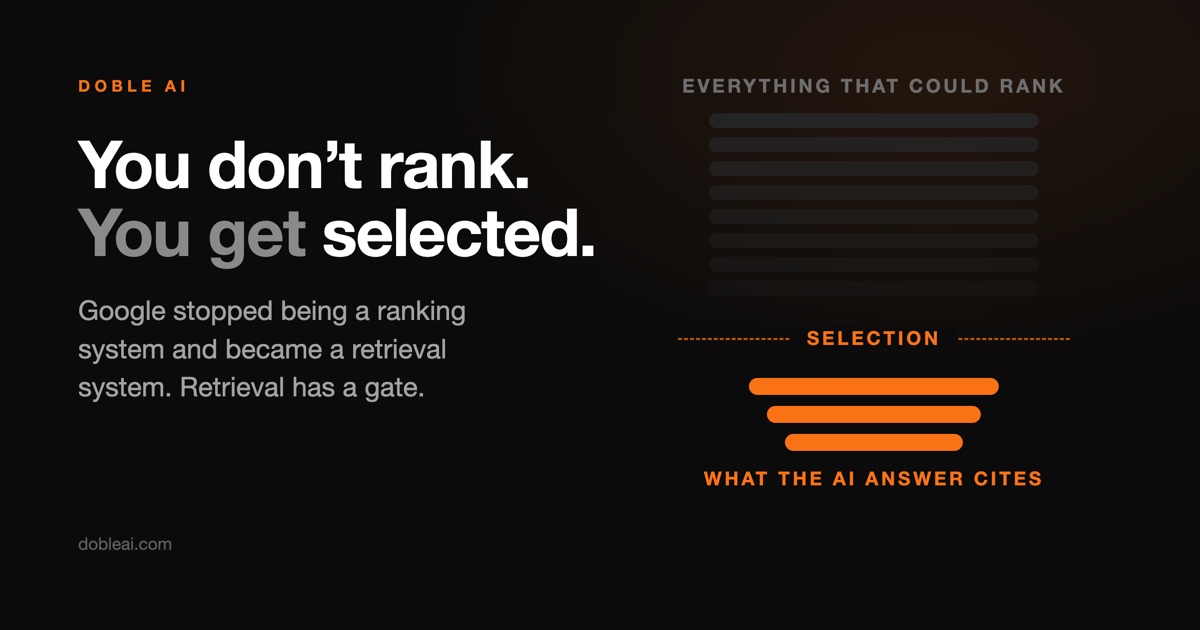
You don't rank into an AI Overview. You get selected.
A number has been going around: AI Overviews now show up on close to half of all Google searches. The exact figure depends on whose tracker you trust, because every study measures a different set of keywords, a different country, and a different mix of phones and desktops. Reasonable measurements this year land anywhere from 25% to 60%. The direction is not in dispute. A year ago the same trackers were reporting around 15%.
Almost everyone reading that number treats it as a traffic story. Fewer clicks, and a line sloping down in Analytics. That reading is true, and it is the smaller half of what happened. The bigger change is that Google quietly switched jobs, and most businesses are still optimizing for the old one.
Ranking and retrieval are not the same system
Ranking sorts. Retrieval selects. That sounds like a distinction without a difference until you notice what happens to everyone who loses.
Under ranking, every page that matched the query was on the board. Position 14 was losing, but position 14 still existed. Somebody scrolled. Somebody hit page two. Somebody found you at the bottom of a list and called anyway. A bad ranking cost you volume. It did not cost you the possibility of being found.
Retrieval does not work that way. When a question comes in and the system composes an answer, it does not weigh every page on the topic. It pulls a small set of sources it already treats as reliable for that kind of question, reads those, and writes from them. If your business is not in that set, nothing else about you gets evaluated. Not your copy, not your backlinks, not your domain authority. You are not ranked badly. You are not ranked.
The sharpest version of this I have seen came from an SEO posting as @Charles_SEO: you don't rank into an AI Overview, you get selected into one. Selection has a gate. Ranking never did.
What does an access problem look like in practice?
It looks like a business with a perfectly good website that AI assistants have never heard of.
We run an AI visibility check as part of every audit. We take the five questions a customer actually asks before hiring someone in that category, ask all five in Google, ChatGPT, Perplexity, and Grok, and screenshot what comes back. The pattern repeats often enough that it stopped being a surprise. The business is real, the site is fine, the reviews are decent, and across twenty answers the business is named zero times. Meanwhile a competitor with an uglier site gets recommended by name in three of the four engines.
The competitor did not win a ranking contest. The competitor was inside the set and our client was outside it.
Why good content still gets skipped
The most common cause is the least glamorous one. The answers are on the site, but they are not in what the server actually sends.
We audited a company earlier this year with the best-built site we had seen all year, genuinely sharp work. Its most important page had a long list of buying questions, each one answered well. Every answer sat inside a click-to-open accordion that the browser filled in after the page loaded. We checked the source the way a crawler receives it: 114 questions on the page, 114 answers missing. A visitor saw a thorough page. A retriever saw a heading and a script tag.
Another site we looked at was built entirely in the browser. Beautiful in Chrome, and effectively a blank page to anything reading the HTML. Its whole business was invisible to the systems now answering half of all searches.
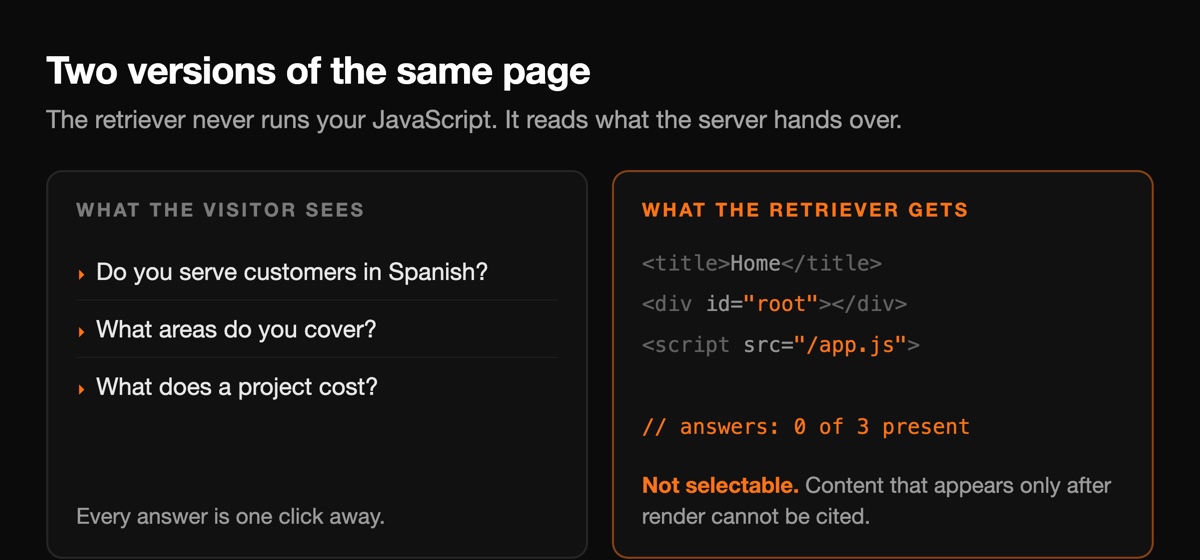
Neither of those is a content problem. Both are access problems, and both are fixable in an afternoon by someone who knows to look. What makes them dangerous is that nothing appears broken. The site loads, the page ranks, the owner has no reason to suspect anything.
What gets a business into the trusted set?
Four things, in roughly this order of neglect.
- The answer has to be in the page source, in plain text, on the page where the question belongs. Not behind a click, not built by a script, not buried in a PDF. If you can right-click, view source, and find the sentence, so can a retriever.
- The answer has to be shaped like an answer. A heading phrased the way a customer asks the question, followed by a direct reply in two or three sentences before any preamble. Retrieval systems lift passages, not pages, and a passage that stands alone is a passage that can be quoted.
- Your business has to be one identifiable entity. Same name, same address, same phone, same service list on your site, on your Google Business Profile, and everywhere else you are listed. Three spellings of your company name reads as three weak signals instead of one strong one.
- Somebody other than you has to say it. Reviews, local directories, chamber listings, a local news mention. When we map which sources the AI answers actually cite, they are frequently not the business's own website. They are the places that talk about the business.
Why this is better news for a small business than it sounds
Ranking rewarded accumulated advantage. Domain age, link budgets, years of published volume. A local contractor was never going to out-authority a national directory, which is why the top of a lot of local searches was owned by companies that do not operate in your town.
Retrieval sets are small and specific to the question. For a broad query the set is crowded and hard to break into. For “who repairs asphalt driveways in Gypsum, Colorado, and speaks Spanish” the set is nearly empty, and the system will pull from whatever thin material it can find. You cannot outspend a national brand on links. You can absolutely be the only clean, complete, corroborated answer to a question about your town.
The language gap is the widest version of this. Ask any of the four engines a buying question in Spanish about most Colorado mountain towns and watch how little it has to work with. That is not a hypothetical opening. It is a category of question with almost no qualified sources, in a valley where a large share of the workforce asks questions that way. That is the same gap we described in reaching the other half of your Colorado market, now showing up one layer deeper. We wrote about the difference between optimizing for search and optimizing for answers if you want the mechanics.
How do you check where you stand?
You can do the first pass yourself this week, and you should, because the results tend to be more persuasive than anything I could write here.
Write down the five questions a customer asks right before they hire someone like you. Ask all five in Google, ChatGPT, Perplexity, and Grok. Screenshot everything. Then fill in three columns: were you named, who was named instead, and what sources did the answer cite.
Then check the plumbing. Pull up your most important page, view the source, and search it for the answers you know are on that page. If the text is not in there, the crawler feeding those engines never saw it either.
That exercise is the front half of every audit we run, and it is the part clients quote back to us months later. Screenshots of four AI engines recommending your competitor by name settle an argument that a traffic chart never quite does. The back half is working out what those competitors are actually doing well, which is the part most owners skip.
The part worth remembering
The businesses that adapt to this will not be the ones that publish the most. They will be the ones that are legible: clear about what they do, answering real questions in text a machine can read, described consistently everywhere they appear, and vouched for by somebody besides themselves.
That has always been decent advice. What changed is the penalty for ignoring it. Under ranking, a business that skipped all of it landed on page three. Under retrieval, it does not land anywhere, and the owner has no idea, because the site looks fine and the phone was always going to ring a little less this quarter for some other reason. The 114 missing answers we found were on the best-built site in the audit. That is the whole problem in one sentence.
Frequently Asked Questions
- What is the difference between ranking and being selected in an AI Overview?
- Ranking sorts every page that matched a query, so a low position still leaves you on the board. Retrieval selects a small set of sources before it writes anything, and everything outside that set is never evaluated. In a ranking system you can be losing. In a retrieval system you can be absent, and absent looks identical to not existing.
- How do I find out whether AI search is recommending my business?
- Write down the five questions a customer actually asks before hiring you, then ask each one in Google, ChatGPT, Perplexity, and Grok. Screenshot every answer. Note whether you appear, which competitors do, and which sources the answer cites. That last column matters most, because it tells you where the trust is coming from and which of those places you are missing from.
- Why does my content not show up in AI answers even though it is on my website?
- Usually because it is not in the HTML your server sends. Answers hidden inside a click-to-open accordion, a tab, or a page that builds itself in the browser are visible to people and invisible to the crawler that feeds AI answers. We have audited sites where every answer on the most important page existed for visitors and none of them existed in the source.
- Does domain authority still matter for AI search?
- Much less than it did. Authority scores were built to predict ranking position, and retrieval is not ranking. What decides selection is whether your business is clearly identified, whether the answer to the question is in plain text on your site, and whether independent sources say the same things about you. A small business can win those on a specific question that a bigger competitor never bothered to answer.
- What should a small business fix first to get cited by AI search?
- Put real answers, in plain sentences, on the pages where the questions belong, and make sure they appear in the page source. Then make your business details identical everywhere they appear: your site, your Google Business Profile, and any directory that lists you. Those two jobs cost nothing but attention, and they are what most local businesses are failing right now.
- Is there an advantage to answering in Spanish as well as English?
- In our market it is the largest one available. Ask an AI assistant a buying question in Spanish about most Colorado mountain towns and the set of sources it can pull from is nearly empty, so it reaches for whatever it can find. A business with genuine Spanish answers written for Spanish speakers, not run through a translator, can become the default source for an entire category of question in a matter of weeks.
Ready to find out where you stand?
Get a free business audit.
We'll review your digital presence, competitive position, and where AI can make the biggest difference, at no charge.
Request your free snapshot
John Rounds
Founder & AI Implementation Specialist at Doble AI. Bilingual AI implementation, with 20+ years of international experience across 50+ countries. Builds and runs AI systems for Colorado businesses in both English and Spanish markets.