Why AI is step four, not step one
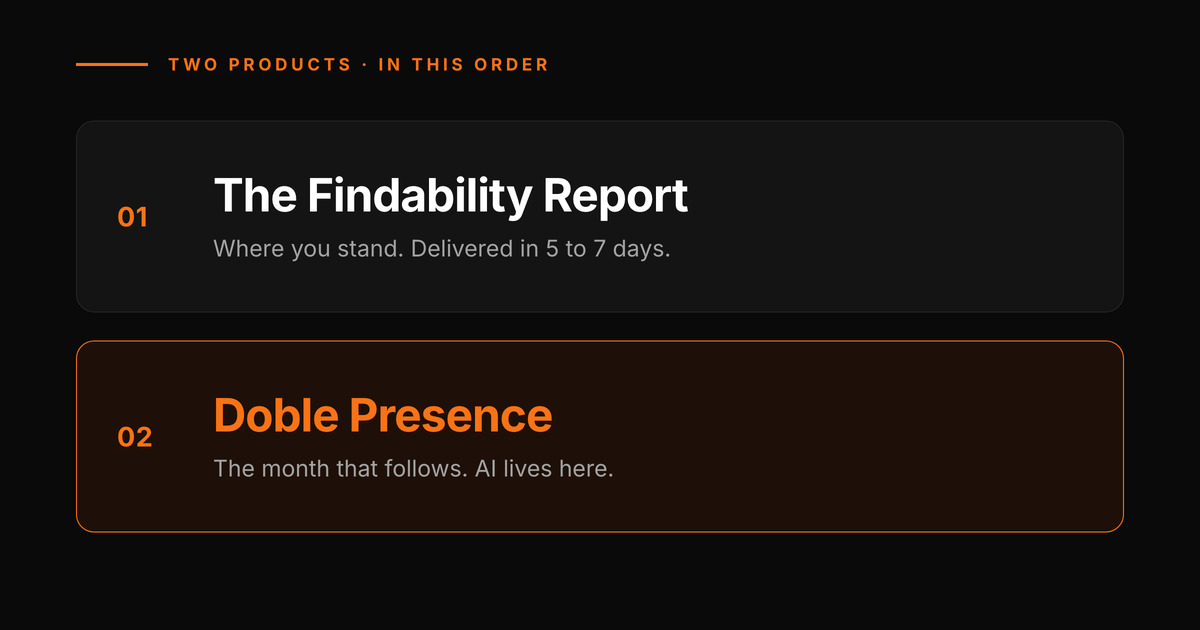
Last summer we changed the order of the services on our own homepage. A small edit: four cards, new numbers. But the order was the whole argument. Audit first, competitive landscape second, brand and sales growth third, AI implementation last. We are an AI implementation firm, and we put AI fourth on purpose.
Since then we have gone further, and the update matters more than the original post did. There are no longer four cards. There are two products: the Findability Report, which tells you where you stand, and Doble Presence, the month that follows. The AI implementation did not get dropped. It moved inside Presence, where it belongs, because it was never a thing you buy on its own.
Here's why, and why we'd give the same order to any small business owner who asks where to start.
Why would an AI firm put AI last?
Because AI is an amplifier. It multiplies whatever your business already produces. If your visibility and your story are strong, AI multiplies that. If customers can't find you, AI multiplies silence, just faster and at higher volume.
Most of the owners we audit are getting pitched AI tools every week. Almost none of them have the foundation those tools need to pay off. Nothing is wrong with the tools. They're being sold out of order.
Product one: find out where you actually stand
Every engagement we take starts with the Findability Report: your website, your Google profile, your reviews, how you show up in search and in AI answers, and how all of that compares to what your customers see when they go looking. You can't fix what you haven't measured, and owners are usually surprised by what the measurement shows. Almost every time, the weak spot turns out to be visibility rather than the product. Ranking in search and being quoted in an AI answer are not the same problem, and a site can pass the first while failing the second.
Inside it: who's winning your market and why
Your gaps only mean something next to the businesses taking your customers, which is why the competitive landscape is part of the Report rather than a second purchase. We map who ranks where you should, what they do well, where they're coasting, and the white space nobody in your market has claimed yet. That last part matters most. In almost every market we've audited, there is an open lane no one is running in. Here is what that analysis actually turns up and why so few owners run one.
Product two: get found, tell your story, and let AI compound it
This is Doble Presence, and it is where the old steps three and four collapsed into one thing. A site that answers the questions customers actually ask. A Google profile with real reviews on it. Content that says what you do in plain language, in Spanish too when your market calls for it. It's the least glamorous work and the highest-leverage, because this layer is what AI has to work with.
And underneath it runs the workspace: persistent memory that learns your business, workflows that accumulate instead of resetting every morning, bilingual agents that publish and review in both languages. Where a month calls for it, a voice agent answers the phone after hours instead of losing the job to voicemail. Ours does; call (970) 406-4630 and you can hear it.
That workspace used to be card four with its own quote. It is now simply how the month gets done, and there is no separate price for it, because selling it separately was selling the amplifier without the thing to amplify. If you want the version of this written as a decision rather than a sequence, we laid out how far to take AI and how to choose your own stopping point.

We ran this order on ourselves
This isn't theory. In July we ran a full prospect-style audit on our own business, the same one we sell. The product side graded well. Our findability graded embarrassingly low. The firm that sells getting found wasn't being found.
So we spent the month on our own findability: fixing structured data, shipping a Spanish homepage, building town pages, working our Google profile, asking for reviews. Our AI was already built. It was waiting on everything else. That experience, more than any sales logic, is why the homepage now shows two products instead of four cards, and why the AI sits inside the second one rather than beside it.
If you take one thing from this, take the sequence. Before you buy an AI tool, spend a week finding out whether customers can find you at all. That is what the Findability Report is for, and the one-page version of it is free.
Frequently Asked Questions
- Should my small business start with AI?
- Usually not. Start by measuring how visible you are to the customers you want: search results, your Google profile, reviews, and what AI assistants say when someone asks about your category. If that layer is weak, fix it first. AI multiplies what already exists, and it pays off far more once there is something solid to multiply.
- What comes before AI implementation?
- Findability. The Findability Report tells you where you stand: whether machines can read your site, whether people can find it, whether AI engines recommend you, and who is winning your market instead. Once that is settled, the AI has something to compound. That is why we sell two products in that order rather than four services in a row.
- How long does each step take?
- The Findability Report is delivered in 5 to 7 days, and the competitive landscape is part of it rather than a separate purchase. Doble Presence is the month that follows, and it is ongoing by design: the build or repair first, then publishing, monitoring, and the AI workspace that runs it. The AI implementation is inside Presence, not quoted next to it.
- I already pay for AI tools. Did I waste money?
- Probably not, but you may be underusing them. A chatbot or a writing assistant helps day to day. The bigger return arrives when the AI is connected to a business customers can actually find, with clean information behind it. Keep the tools; fix the foundation they sit on.
- Can I skip straight to the AI part?
- Sometimes. A business with a strong site, steady reviews, and real visibility has already done the earlier work, whether or not it called it that. The Findability Report is how you find out. If the foundation checks out, going straight to Doble Presence is exactly right, and the AI workspace comes with it.
- Does the order change for a bilingual market?
- The order stays the same; the work inside each step changes. The audit looks at how you show up in English and in Spanish, the competitive analysis usually finds that almost nobody is serving Spanish speakers well, and the brand work covers both languages. By the time AI arrives in step four, it is bilingual from day one.
Ready to find out where you stand?
Get a free business audit.
We'll review your digital presence, competitive position, and where AI can make the biggest difference, at no charge.
Request your free snapshot
John Rounds
Founder & AI Implementation Specialist at Doble AI. Bilingual AI implementation, with 20+ years of international experience across 50+ countries. Builds and runs AI systems for Colorado businesses in both English and Spanish markets.