A second brain is an architecture, not an app

Tiago Forte's version of a second brain was a filing cabinet you trusted more than your own head: notes, tags, a place for everything. Plenty of owners built one. Almost none of them run the business from it. The cabinet filled up. The work stayed in the same chats that forget you overnight.
That is not an argument against the idea. It is an argument that the idea was waiting on tools that did not exist yet.
What is a second brain supposed to do?
Hold the business when you are not in the room.
Not “store your notes.” Hold the jobs: the phone, the follow-ups, the weekly check that the site still loads, the draft you would have written if you had an afternoon. Remember the decisions so you do not re-brief a stranger every Monday. Put a human on anything that can reach a customer or move money.
If it cannot do work while the laptop is closed, it is still a notebook.
We already wrote the roster version of this in July: one person, five agents. This post is the wiring under that roster. Without the wiring, five agents is just five more chats.
Why did the notes version stall?
Because memory without a job is a hobby.
A Notion wiki does not answer the phone. A ChatGPT thread does not know last month's price list unless you paste it again. A folder of PDFs does not notice when a page went blank overnight. Owners treated “second brain” as a place to put information, then wondered why nothing compounded.
The other stall is starting with tools. You collect a chatbot, a note app, a scheduler, a voice agent, and you still have one brain doing all the routing. The architecture is the routing. The tools sit on top of it.
What does the architecture actually look like?
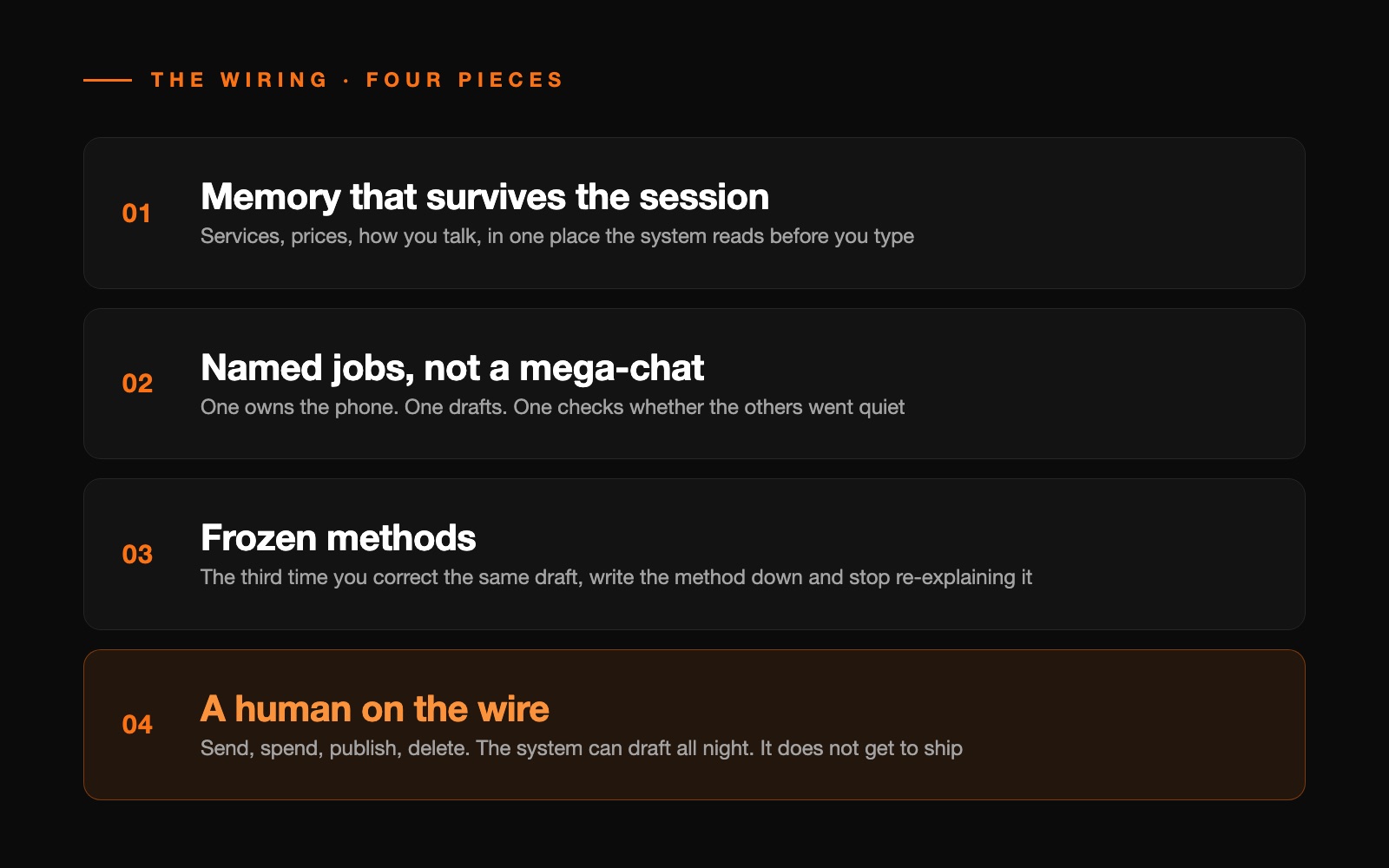
Four pieces. Skip one and it falls back into a chat window.
Memory that survives the session. Services, prices, how you talk, the mistakes you refuse to repeat, sitting in one place the system can read before you type. This is the piece we called your AI should know your business in April. It is still the first piece. Hire jobs before you have this and every agent wakes up a stranger.
Named jobs, not a mega-chat. One place that owns the phone. One that drafts. One that checks whether the others went quiet. A general helper that does everything builds context that transfers to nothing.
Frozen methods. The third time you correct the same draft, you are teaching. Write the method down: when to use it, what it needs, how you know it worked, what still needs you. Then stop re-explaining it.
A human on the wire. Send, spend, publish, delete. The system can draft all night. It does not get to ship. That checkpoint is the reason the pairing beats either side working alone.
None of that requires a custom platform. It requires deciding those four things out loud.
Which tools exist now?
The consumer versions caught up this year. You can rent a workspace that keeps files and logins, teach it a task by doing the task once, and put the result on a schedule. Mail, calendar, and a Git repo plug in without a developer. Voice agents answer the phone in both languages. None of that was true when the first second-brain books came out.
You do not need all of it. You need memory, one job, and a checkpoint. Our bilingual receptionist is the proof we use because it is the least abstract: the line is (970) 406-4630, it answers when nobody is in the office, and a person still reads the lead. That is a second brain doing a job, not a notes app with a nicer prompt.
The temptation is to install a marketplace of other people's methods. Don't. A method you did not read is a stranger with your logins.
Where should you start?
Not with five agents. With the leak.
Write down how the business actually works, in the ugly detail: hours, prices, who you never discount for, what “done” looks like on a quote. Put that where the system can read it. Then pick the one job that loses you money when it slips. For most of the owners we meet, that is the phone. For some it is the follow-up that never goes out. Run that job with the system for two weeks. Correct it. Then freeze the method. Then put it on a clock.
That order is the same one we argue everywhere else: the AI part comes fourth, not first.
If you skip those steps you will have a beautiful stack that still needs you in the chair. We run a cloud desk for the hours the laptop is closed and a separate workspace for the files that have to change on disk. That split is boring. It is also why the second brain still works when I am not at the desk.
Run the first job for two weeks. If it is still saving you a leak, freeze it. If it isn't, you only lost two weeks.
Frequently Asked Questions
- What is a second brain, in this sense?
- A system that holds the business when you are not in the room: persistent memory, named jobs, frozen methods, and a human on send, spend, publish, and delete. If it only stores notes, it is still a notebook.
- Is this just ChatGPT with memory turned on?
- No. Memory is the first piece, not the whole thing. A chat that remembers your prices still needs a job, a way to know the job worked, and a person who has to approve anything that reaches a customer.
- How is this different from Notion or a notes app?
- Those are filing cabinets. They do not answer the phone, notice a dead page, or draft the follow-up you skipped. The architecture puts work on top of the memory, then puts a person on the output.
- Do I need to know how to code?
- Mostly no. The workspaces, voice agents, and schedulers are configured in plain language now. What you do need is to write down how the business actually works, and the patience to run one job by hand until it is boring.
- What should I build first?
- The leak. For most service businesses that is the phone. Write the memory, run one job for two weeks, freeze the method, then put it on a clock. Five agents on day one is how you get five quiet failures.
- Can this work in English and Spanish?
- Yes, and for our markets that is the point. The receptionist already greets in both languages. The methods have to be written in both, not translated after the fact. A person still steers the Spanish so it sounds native.
- Is this the same as the five-agent team you wrote about in July?
- That post was the roster. This one is the wiring under it. You can build the architecture with one job. The five agents are what it looks like after the wiring has been earning its keep.
Ready to find out where you stand?
Get a free business audit.
We'll review your digital presence, competitive position, and where AI can make the biggest difference, at no charge.
Request your free snapshot
John Rounds
Founder & AI Implementation Specialist at Doble AI. Bilingual AI implementation, with 20+ years of international experience across 50+ countries. Builds and runs AI systems for Colorado businesses in both English and Spanish markets.