One person, five agents: how to build your own AI cloud team
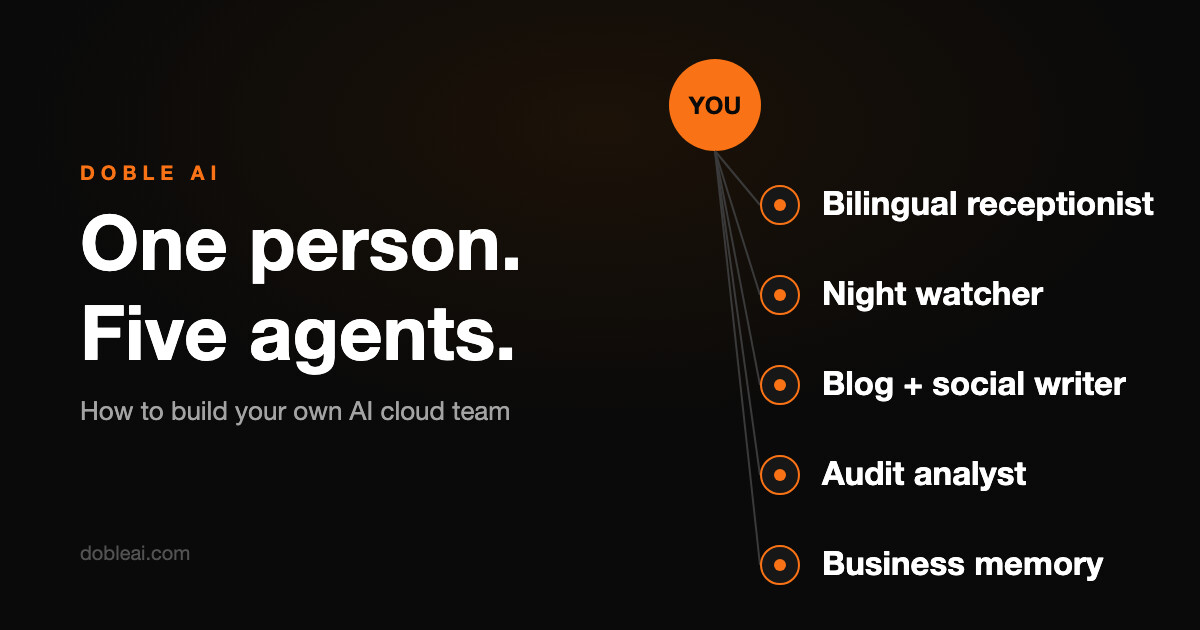
Every “we” on this website is technically true. Doble AI has a receptionist who answers the phone in two languages, a night watchman who checks every site before sunrise, a writer, an analyst, and a memory that never loses a detail. It also has exactly one human, and I sleep.
This post is the playbook for that team. Publishing it feels backwards for a company that builds these systems for a living. We're doing it anyway, partly because the pieces stopped being secret a while ago, and partly because the hard part of an AI team was never the setup. The hard part shows up around week three, and there's a section on it below.
What is an AI cloud team?
A cloud team is a set of AI agents that each own a recurring job in your business. Not a chatbot you visit when you remember to. Agents run on schedules and triggers, do their work whether or not you're at a desk, and report to one human who checks what matters. If you read our post on restructuring around AI, this is that org chart in practice: one owner directing systems instead of a stack of roles.
Meet the five agents
The receptionist answers our business line around the clock in English and Spanish and emails me a lead summary a minute after each call ends. She exists because an after-hours caller who hits voicemail dials the next number on the list. We wrote up how she works if you want the detail.
The watcher clocks in at 7 every morning. It loads every site we're responsible for, checks the data feeds behind our river and weather dashboards, confirms the receptionist's lead emails still have a pulse, and flags anything that changed overnight. It files a report even when nothing broke. That detail matters more than it sounds, and it gets its own section below.
The writer drafts posts like this one in both languages, resizes social graphics into the formats each platform wants, and burns subtitles onto vertical video. A human edits everything before it ships. The writer's job is to make publishing cost an hour instead of an afternoon.
The analyst is the agent that surprises people, and the one I'd fight hardest to keep. Give it a business name and a market and it comes back with the kind of picture that used to take a week of desk research: every competitor's site read closely, who ranks where and why, what the Google profiles and reviews look like, how each business shows up when a customer asks ChatGPT or Perplexity for a recommendation, and where the open lane is that nobody in the market is running in. It reads at a volume no human can match. It has read more small business websites this year than I will in my life.
That horsepower is the engine behind the audits we sell, and it has changed our day-to-day decisions too. Pricing a new service, sizing up a town we haven't worked in, deciding whether a niche deserves its own page: each of those now starts with an hour of the analyst sweeping the market instead of a guess.
The clearest example is real estate. For one realtor client, the analyst read the sites and marketing of the top-producing agents across two luxury mountain markets: what they publish, what they skip, whose brand their brokerage is actually building, and the gaps every single one of them shares. That's the market picture a big brokerage's research department used to own, and it came back in an afternoon. A human still verifies and signs every finding before it reaches a client. What changed is how much ground we cover before judgment kicks in.
The memory is the least visible agent and the one that makes the rest work. It's a persistent record of every client, price, decision, and lesson, kept where the other agents can read it. Without it, each agent wakes up a stranger to the business. With it, the receptionist knows the service list and the writer knows the house style without being told twice. It's also why the team compounds: a lesson learned on one client's project becomes a rule every later project inherits, so the whole system is sharper this month than it was last month.
How do you actually build one?
Here's the sequence we'd hand any owner who wants to try it. It's the one we followed, cleaned up with hindsight. It assumes you are past the chat-window stage, which is its own progression: most people are still at level one or two, and the jump that matters is training a tool instead of just using one.
- List the jobs, not the tools. Write down the recurring work that eats your week or leaks money when it slips: the phone, the follow-ups, the posting, the checking. Your first agents come from that list, never from a tool demo.
- Give the team a memory before you give it work. Write down what your business knows: services, prices, hours, how you talk to customers, the mistakes you refuse to repeat. Keep it in one place an AI workspace can read. This one step improves every agent you add later.
- Hire one agent and make it boringly reliable. Start with the job guarding your biggest leak. For most service businesses that's the phone. Run it for two or three weeks, read every report it produces, and fix what it gets wrong before you add a second.
- Put a human checkpoint wherever a mistake could reach a customer. Our writer drafts and a person publishes. Our analyst assembles and a person signs. The receptionist talks to customers directly, so she gets the narrowest job description on the team and hands off anything unusual.
- Hire a watcher before you hire agent number four. Automations rarely crash loudly. They stop quietly, and you find out from a customer weeks later. One agent whose entire job is checking the others is what makes the team trustworthy.
What does it cost to run?
Less than most owners guess. The software behind our five agents comes to a few hundred dollars a month: an AI workspace subscription, a voice platform that bills by the minute (ours runs on Vapi with Claude as the brain), and a small automation service that moves the lead emails. That's less than one weekend shift of a part-time employee.
The expensive input is attention. A few focused hours a week reading the watcher's reports, correcting the writer's drafts, and tightening instructions when an agent gets something wrong. Skip those hours and the team drifts. That's the real price, and no subscription covers it.

The part that actually gets hard
Silent failure. This month a portfolio site we monitor lost 10 of its 13 videos overnight when a hosting plan changed. The pages loaded fine. Nothing errored. Every player just sat there saying the video didn't exist. The watcher caught it against the previous day's baseline, and the owner knew before almost any visitor did.
Our own plumbing has the same weakness. The service that moves the receptionist's lead emails can pause itself when it hits a plan limit, and a paused automation looks exactly like a quiet week. She would keep answering calls perfectly while the leads evaporated. So the watcher checks her too.
This is the piece of the playbook that doesn't compress into a checklist. Setup is a weekend. Distrust is a discipline. Every agent on the team exists because something used to slip, and the watcher exists because the agents themselves can slip.
Should you build it yourself?
If you enjoyed reading this, honestly, maybe. The pieces are consumer grade now. You don't need to code; you need to write down how your business works and be stubborn about checking. Most owners we meet don't stall at setup. They stall in week three, when the novelty is gone and the reports need reading.
The other path is building it with someone who has already made the mistakes. The parts are cheap. The months of tuning underneath our five agents are not: the written knowledge base they all read from, the checks that caught real failures, the voice work that makes the Spanish sound native. That layer is what you'd actually be hiring, and it's the part that transfers. Either way, start with one agent and the leak it guards. Our receptionist answered her first after-hours call the week she was hired, and that call became a job. That's the whole pitch for a cloud team: it was a Tuesday night, nobody was working, and the business answered anyway.
Frequently Asked Questions
- What is an AI cloud team?
- A set of AI agents that each own a recurring job in a business: answering the phone, monitoring sites, drafting content, running research. They run on schedules and triggers in the cloud, work when nobody is at a desk, and report to one human who reviews what matters.
- How much does it cost to run a team of AI agents?
- Ours costs a few hundred dollars a month across an AI workspace subscription, a voice platform billed by the minute, and a couple of small automation services. That is the software side. The real cost is a few hours of human attention each week to read reports and correct course.
- Which AI agent should a small business build first?
- The one guarding your biggest leak. For most service businesses that is the phone: a bilingual AI receptionist can pay for itself with one saved job. If you never miss calls but never publish, start with a writer instead. Build one, make it reliable, then add the next.
- Do I need to know how to code to build an AI agent team?
- Mostly no. Voice platforms, AI workspaces, and automation tools are configured in plain language now. What you do need is to write down how your business actually works, in detail, and the patience to test each agent against real situations before you trust it.
- How do I know if my AI agents are still working?
- You don't, unless something checks. Automations tend to stop quietly instead of crashing loudly. Give one agent the job of checking the others every day, and have it report even when everything is fine, so that a missing report is itself an alarm.
- Can AI agents work in both English and Spanish?
- Yes, and for our markets that is the whole point. Our receptionist greets callers bilingually and continues in whichever language the caller uses. Our writer drafts every post in both languages. A person still steers the voice so the Spanish sounds native rather than translated.
Ready to find out where you stand?
Get a free business audit.
We'll review your digital presence, competitive position, and where AI can make the biggest difference, at no charge.
Request your free snapshotJohn Rounds
Founder & AI Implementation Specialist at Doble AI. Bilingual AI implementation, with 20+ years of international experience across 50+ countries. Builds and runs AI systems for Colorado businesses in both English and Spanish markets.