GrokBot or Claude? The chat window is not the product
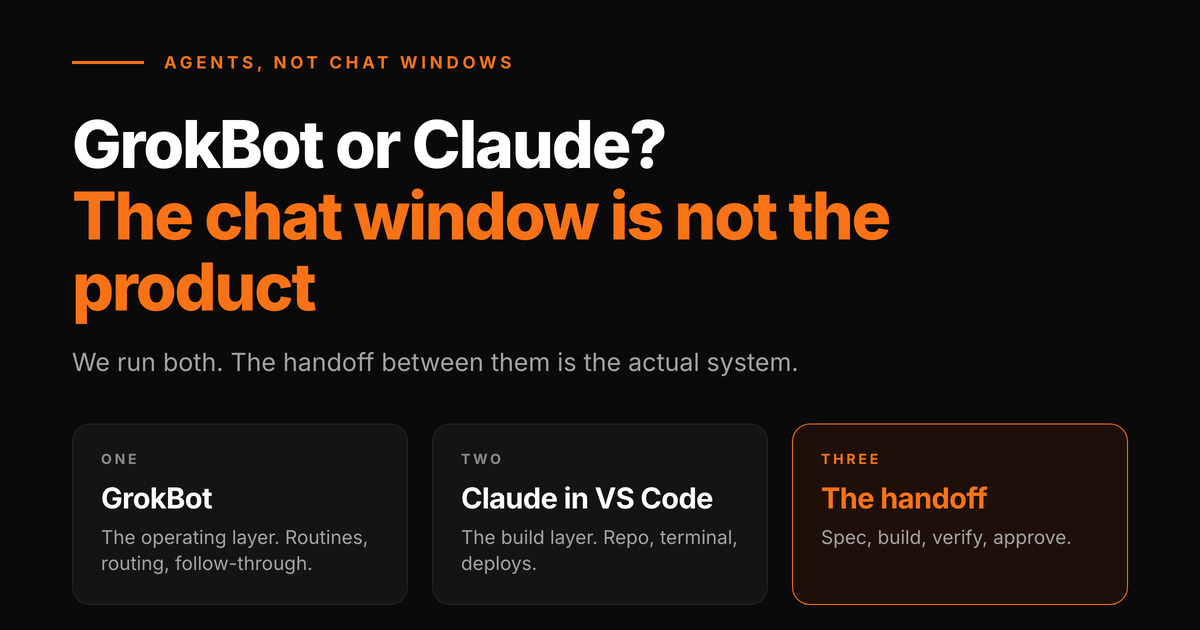
The question arrives in the same shape every time. Somebody has been typing into a chat window for a year, they have seen a demo of an agent working with nobody in the room, and they want to know which one to buy.
It is the wrong question, and I say that as someone running agents on two platforms at once. The model is close to the least interesting decision here. What separates a chatbot from an agent is five things you put around it, and those five are identical whoever built it.
What actually makes something an agent?
A chatbot waits. You open it, you type, it answers, you close the tab, and everything you just established about your business is gone. Tomorrow you explain it again.
An agent has a job it does whether you show up or not. That takes five pieces, and none of them are the model. A job: one named responsibility, not “help me with stuff.” Context that survives the window closing, so it knows your clients, your prices, and the mistake you made in March that you refuse to repeat. Tools it can actually reach, which is the difference between telling you the page is broken and fixing the page. A trigger that is not you: a schedule, an inbound call, a file landing in a folder. And somewhere the work lands where a person will find it.
Take any one away and you are back to a chat window with a better name. Put all five around an ordinary model and you have something that runs your Tuesday for you.
How far past a chatbot does this go?
A version making the rounds stacks it in five steps: chatbot, coding assistant, loop, graph, teammate. Most business owners I talk to are standing on the first rung and shopping for the fifth.
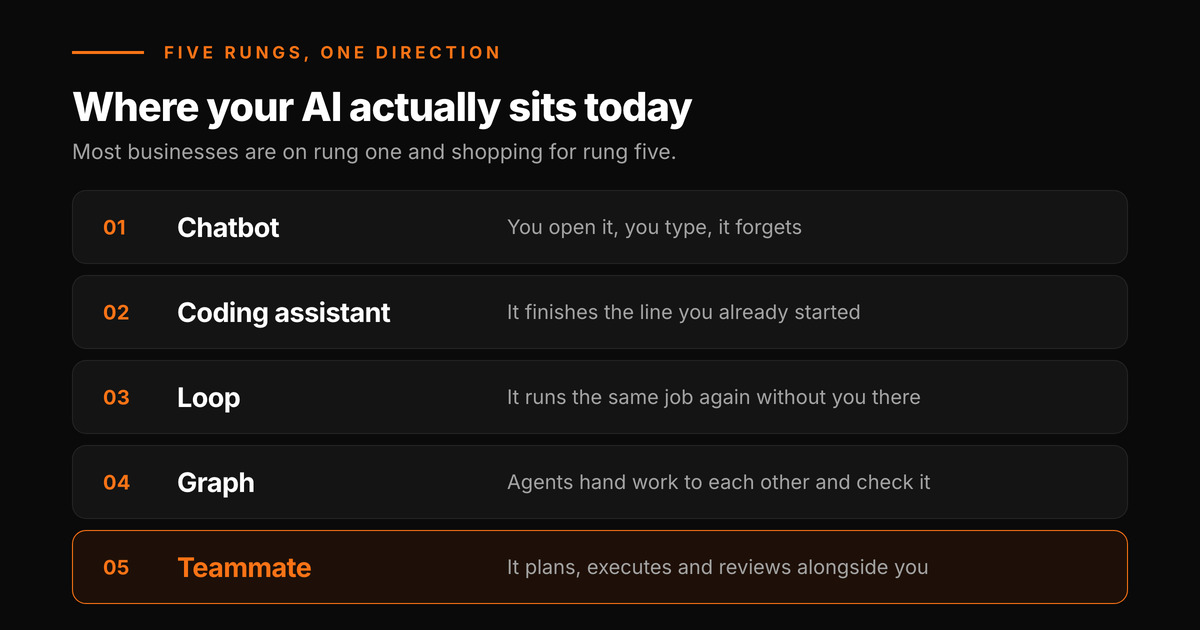
A loop is the same job running again without you starting it. A graph is several agents handing work to each other and checking what comes back. A teammate is what you have when the graph is reliable enough that you stop watching every step and start reviewing results. The return starts at rung three, reachable this month without writing a line of code.
Is GrokBot good enough for most people?
Right now, for most people, it is the best entry point available, and I do not say that as a Grok partisan. The place almost everyone dies is the setup tax, and GrokBot removes most of it. You describe the job in plain language, point it at the accounts it needs, and it runs. You can hand it a routine and walk away from the keyboard, which was not true of consumer AI a year ago.
Our chief of staff agent lives there. It routes work, keeps specialists on call, logs into the browser-shaped parts of the business a terminal cannot touch, and follows through while I am somewhere else. It is not the most powerful thing we run. It asked the least of me to start.
What does Claude in VS Code do that GrokBot does not?
It owns the parts of the business that live in files. The repository. The terminal. The deploys. The long work of reading forty documents to find the one number that contradicts the other thirty-nine. Memory on disk as files I can open and correct.
That is the difference between an agent that reports a problem and an agent that closes it, which we argued about in April: you are using Claude, but you are not training it.
The cost is real. You are managing files, and when something breaks you have to read what broke. It is a steeper start than GrokBot and I would not send someone there first.
Why run both instead of picking one?
They cover different halves, and the handoff between them turned out to be the part that matters. Neither would be better if I forced it onto the other platform, and that is the claim here I am most confident about, because I have tried it.
The loop is spec, build, verify, approve. A brief gets drafted in one place and pressure-tested in the other. When one model drifts, or reads a design problem as a factual one, the other catches it, and I would rather find that on my own screen than in a client's inbox.
That is redundancy, not busywork. The distinction is whether the second pass can actually disagree with the first. Two agents on one platform share the same blind spots, so they mostly agree, which feels like verification and is not.
It is not free either. You feed two memories instead of one, and you have to decide which half owns a job, or the work gets done twice, or dropped because each side assumed the other had it. If you will not maintain both, run one loop on the easier platform and stay there until you hit a wall.
What does this look like on a normal Tuesday?
At seven in the morning, before anyone is awake, a watcher runs nineteen checks across the sites we are responsible for and says something only if one of them broke quietly overnight. Nobody starts it.
Our phone is answered in English or Spanish by an agent that takes the caller's details and emails the lead before a human has looked at a screen. We wrote that one up in the bilingual receptionist post. It runs on the Grok side.
The client work runs on the other side, with about a hundred small files of memory behind it. Which client sites deploy with a script instead of a push, because I broke one that way once. Which Spanish words we do not use. Which claims are still unverified and cannot go in front of a client. It went in one correction at a time, usually right after something went wrong. The roster version is here: one person, five agents.
Where do you start?
Start on the easier platform, with one job you keep forgetting to do. Not the most important job. The one you resent, because you will need the motivation in week three when the first version is worse than doing it yourself.
Give it the five pieces. Name the job, write down the context and keep writing it every time it gets something wrong, connect it to the accounts it needs, put it on a schedule, decide where the output lands. Then leave it alone for a week.
You move it down to the harder layer when you hit the wall, and the wall is specific: it needs to change something in a system it cannot reach. Not before. Most people shop for the powerful tool first and never get an agent running at all.
The roster we published in July has already moved one agent onto a different platform, and nothing underneath it changed. That is why I am not nervous about whatever ships next spring.
The end goal is not a bigger roster. It is less of your week spent on the repetitive grind and more of it spent on judgment, on high-level thinking, on the decisions only a person should be making. Agents take the loop work. You keep the taste and the call.
Frequently Asked Questions
- What is the difference between an AI chatbot and an AI agent?
- A chatbot waits for you to open it and forgets everything when you close the tab. An agent has a named job, a trigger that is not you, context that survives between runs, tools it can reach, and a place the work lands. The model can be the same in both cases. The five pieces around it are the difference.
- What is an agent loop, and what is an agent graph?
- A loop is one agent doing the same job again on a trigger you set once. A graph is several agents handing work to each other, one drafting and another checking. For most small businesses the return starts at the loop, and a loop does not require code.
- Is GrokBot or Claude better for a small business?
- They are better at different halves. GrokBot is the easier start and the better home for always-on work: routing, routines, browser logins, follow-through with nobody at a keyboard. Claude in a code editor is better for anything touching files, repositories or deploys. If you will only run one thing this year, start with the accessible one.
- Do I need to know how to code to build an AI agent?
- Not for your first one. The hard part is describing the job clearly enough that something else can follow it, and that is writing, not programming. Coding matters when you need an agent to change something inside a system it cannot reach from a browser, and most businesses take months to hit that wall.
- Is it worth running two AI platforms instead of one?
- It is worth it when the second one can genuinely disagree with the first. Two agents on one platform share the same blind spots, so they mostly agree, which feels like verification but is not. The cost is two memories to feed and a decision about which half owns each job. If you will not maintain both, run one.
- What is the first agent a small business should build?
- The job you keep forgetting to do, not the most important one in the business. You need the annoyance to carry you through week three, when the first version is still worse than doing it by hand. Answering the phone, checking whether anything broke overnight, and drafting the thing you rewrite every week pay back fastest.
- Will I have to rebuild everything when a better model comes out?
- No, and that is the argument for learning the structure rather than the tool. The job, the context, the tool access, the trigger and the destination all carry over. We moved pieces of our own roster between platforms this year and rebuilt none of the thinking underneath. The model gets replaced. The architecture is what you keep.
Ready to find out where you stand?
Get a free business audit.
We'll review your digital presence, competitive position, and where AI can make the biggest difference, at no charge.
Request your free snapshot
John Rounds
Founder & AI Implementation Specialist at Doble AI. Bilingual AI implementation, with 20+ years of international experience across 50+ countries. Builds and runs AI systems for Colorado businesses in both English and Spanish markets.